
When Mughal Emperor Jahangir established his military headquarters in Burhanpur, Madhya Pradesh in the early 17th century, over 200,000 soldiers and 35,000 residents flooded into the semi-arid settlement. Despite being situated along the Tapti and Utavali rivers, the riverbanks were so high and steep that pumping water to the city was impossible with 1600s technology. An urgent, permanent hydraulic solution was needed.
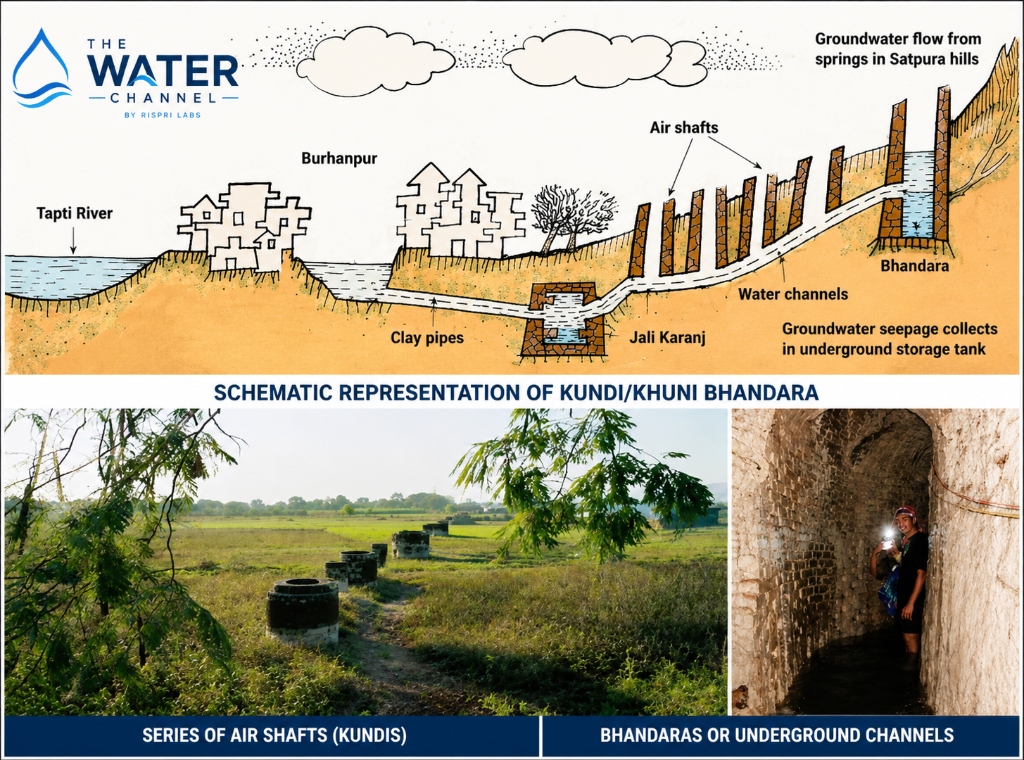
Hydrogeological Schematic Diagram
1. The Persian Qanat Transferred to Central India
In 1615 CE, Subedar Abdur Rahim Khan-i-Khanan invited Tabkutul Arz, a master geologist from Persia, to investigate the hydrogeology of the Tapti plains. Arz identified a natural fault line sloping gently from the adjacent Satpura hill range toward the Tapti River. Rather than letting monsoon rainwater drain into the river basin, Arz devised an underground interceptor network inspired by the Persian Qanat systems of Iran and Iraq.
2. How the 3.9 KM Subterranean System Works
The Khooni Bhandara network is composed of eight interconnected waterworks (including Mool Bhandara, Chintaharan Bhandara, Sookha Bhandara, and Khooni Bhandara). The technical design functions across four distinct stages:
Groundwater Interception (Satpura Hills)
Four primary storage reservoirs (bhandaras) dug northwest of Burhanpur intercept subsoil water flowing from the Satpura mountain ranges, pooling mineral-rich spring water.
3.9 KM Subterranean Marble Aqueduct
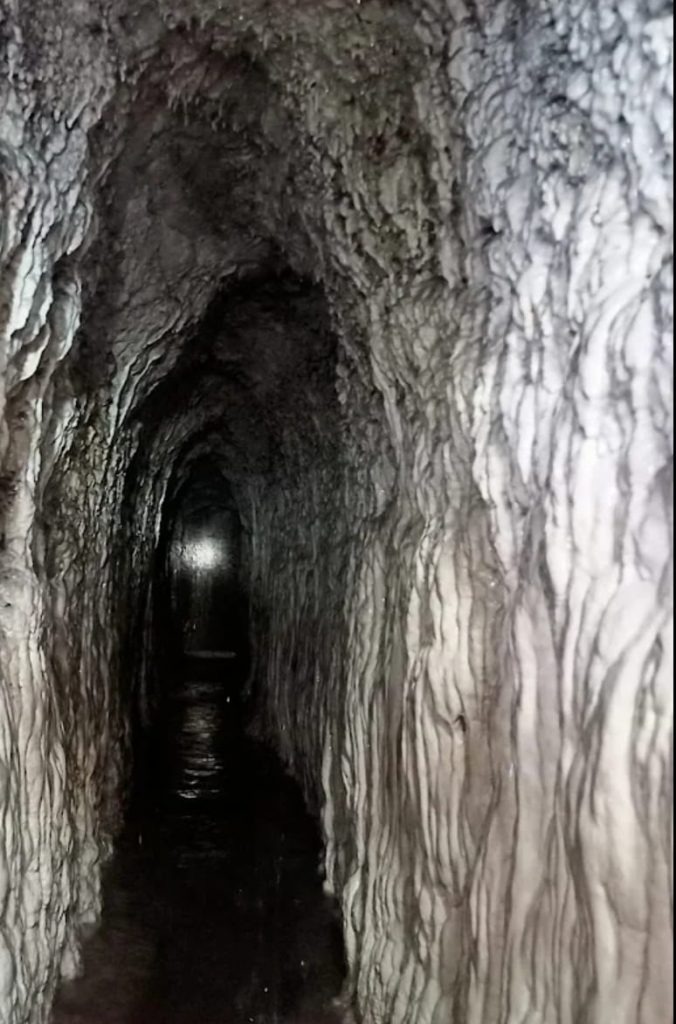
Water flows through a 3.9 km long continuous subterranean tunnel excavated 80 to 100 feet (24 to 30 m) underground. The tunnel floor is lined with smooth marble to reduce hydraulic friction.
103 Kundis (Air Ventilation & Maintenance Shafts)
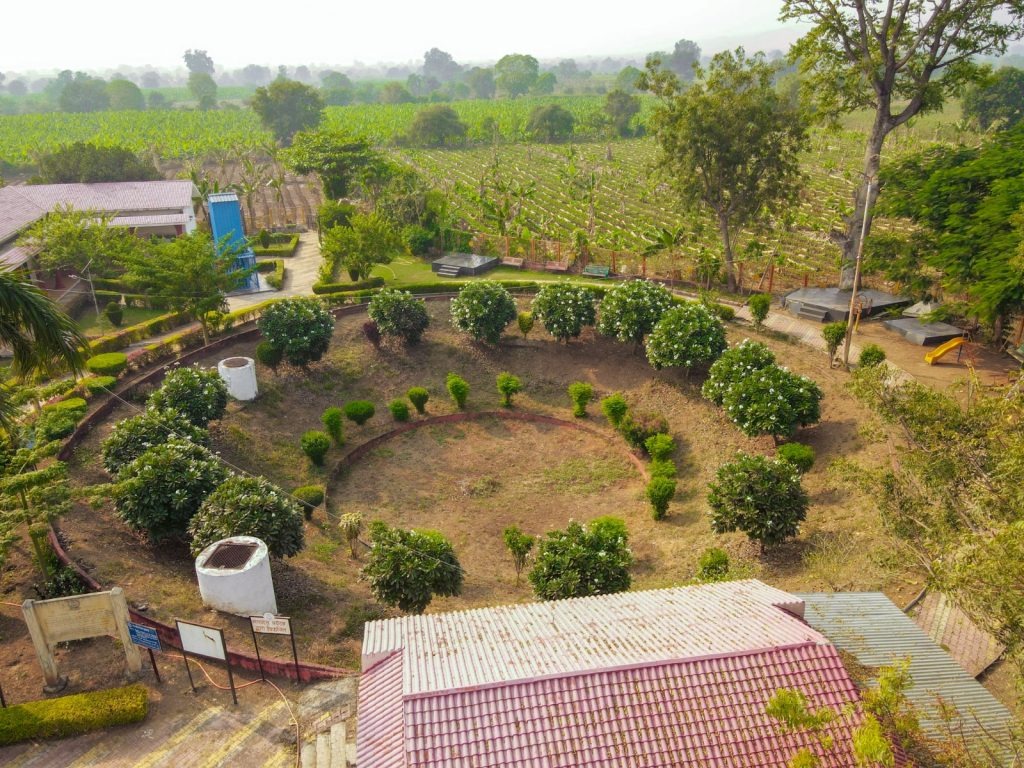
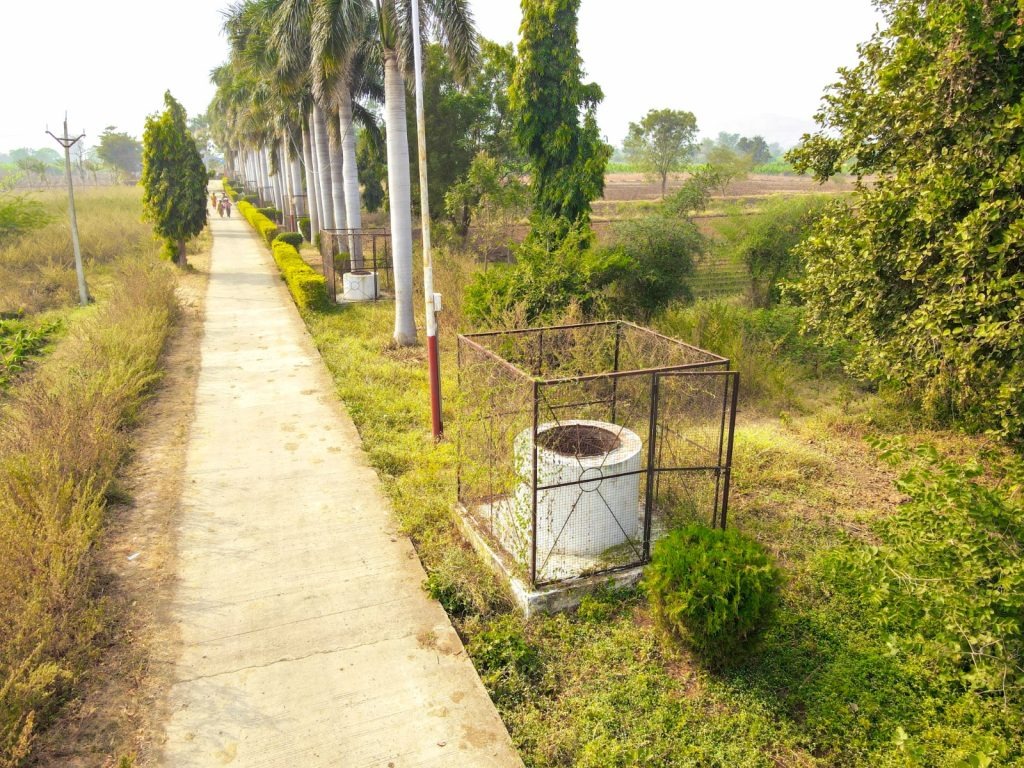
Constructed in a straight line spaced 30 to 100 meters apart, 103 vertical well-like shafts provide fresh air ventilation to prevent anaerobic stagnation and allow maintenance access via iron ladders.
Jail Karanj & Urban Pipeline Distribution
The underground aqueduct delivers water to a central junction chamber called Jail Karanj (situated 33 meters above the river bed), from where terracotta and masonry pipelines distribute pressurized water across Burhanpur city.
Field Photographic Records
 Click to zoom
 Click to zoom
 Click to zoom
3. Why Is It Named 'Khooni'?
The name Khooni Bhandara (Bloody Reservoir) is rooted in local folklore and hydro-chemistry. The subterranean water passing through the iron and calcium-rich basalt rock of the Satpura formations absorbs natural iron oxides and calcium carbonate. When viewed under sunlight in the marble chambers, the mineral-dense water exhibits a faint reddish-copper glow, leading locals to call it Khooni Bhandara.
4. UNESCO World Heritage Value Criteria
Submitted to the UNESCO Tentative World Heritage List on August 2, 2024 (Ref. 6731) under the Cultural Category, Khooni Bhandara satisfies three key universal value criteria:
UNESCO Selection Criteria Summary
Demonstrates the historic exchange of Persian qanat engineering principles adapted to the basaltic geology and monsoon regime of Central India under the Mughals.
An exceptional surviving testimony to medieval subterranean water management in semi-arid environments, maintaining active function for over 400 years.
An outstanding example of gravity-driven subterranean hydraulic architecture comprising 103 kundis, marble aqueducts, and zero-energy urban distribution networks.
5. Global & Indian Comparative Heritage Systems
Subterranean qanat engineering evolved across arid regions globally to conquer water scarcity without fossil fuels or electrical power:
| Hydraulic System | Location / Country | Key Feature | UNESCO Status |
|---|---|---|---|
| Khooni Bhandara | Burhanpur, India | 3.9 km marble aqueduct, 103 kundis, 1.8 MLD zero-cost supply | Tentative List (2024) |
| The Persian Qanat | Yazd / Mashhad, Iran | 34,000+ active ancient qanats tapping mountain aquifers | Inscribed (2016) |
| Aflaj Irrigation Systems | Oman | 5 gravity-driven underground channels tapping spring water | Inscribed (2006) |
| Nahar-e-Ambari | Aurangabad, India | 52 rock-cut underground aqueducts built by Malik Ambar (1617 CE) | State Protected |
| Augsburg Water System | Augsburg, Germany | Medieval canal and hydro-technical water management ensemble | Inscribed (2019) |
6. Modern Revival: 1.8 MLD at Zero Operational Cost
Originally designed to yield 10 million liters per day (10 MLD), the system suffered partial blockage in 1977 due to calcium carbonate encrustation. In recent years, the Burhanpur Municipal Corporation partnered with district authorities to desilt the marble aqueduct and restore structural integrity.
Today, Phase-1 of the restoration yields 1.8 million liters per day (1.8 MLD) of fresh drinking water - supplying whole municipal wards of Burhanpur at zero electricity cost. As modern cities grapple with soaring power bills and depleted water tables, Khooni Bhandara stands as a timeless masterclass in zero-carbon water engineering.